
Nov 10, 2026 · @Dr. Arash Zaker Shahrak
If you've just had a tooth out, or you're about to, it's natural to wonder what the next few days will bring. Many people recover from a straightforward extraction within one to two weeks, helped by a little rest, soft food and simple painkillers. Everyone is different, though, and your recovery will depend on you and on the procedure you've had.
In my work as a specialist oral surgeon at NDU Clinic, the same worries come up time and again. Is this much bleeding normal? Why does my face look more swollen today than yesterday? When should I actually pick up the phone? I've written this guide to answer those questions in plain language, so you can feel more in control of your recovery.
The first 24 hours: look after the blood clot
Think of the blood clot in the socket as nature's own plaster. It protects the area and gives new gum and bone something to grow into. Most of what I'll ask you to do on day one is simply about leaving it undisturbed.
Bite on the gauze. Keep firm, steady pressure on it for about 30 minutes. It's tempting to peek, but try not to keep taking it out to check.
Hold off on rinsing and spitting for the rest of the day. Just swallow your saliva as normal.
Avoid straws, smoking and vaping. The suction and the nicotine can disturb the clot and may slow healing.
Let the numbness wear off first before you eat or have a hot drink. It's surprisingly easy to bite your lip or burn your mouth when you can't feel it.
Take it easy. Rest with your head raised, and use an extra pillow at night. Leave the gym and any strenuous exercise for 24 to 48 hours.
Skip the alcohol for at least 24 hours, and while you're taking painkillers.
Try a cold compress on your cheek for 10 to 20 minutes at a time during the first day. Many people find it helps keep the swelling down.
What's normal in the days afterwards
Healing rarely follows a perfectly straight line, and some things that look worrying are actually a common part of the process. Here's what many of my patients notice. Everyone heals in their own way, so if you're ever unsure whether something is normal for you, just give us a call.
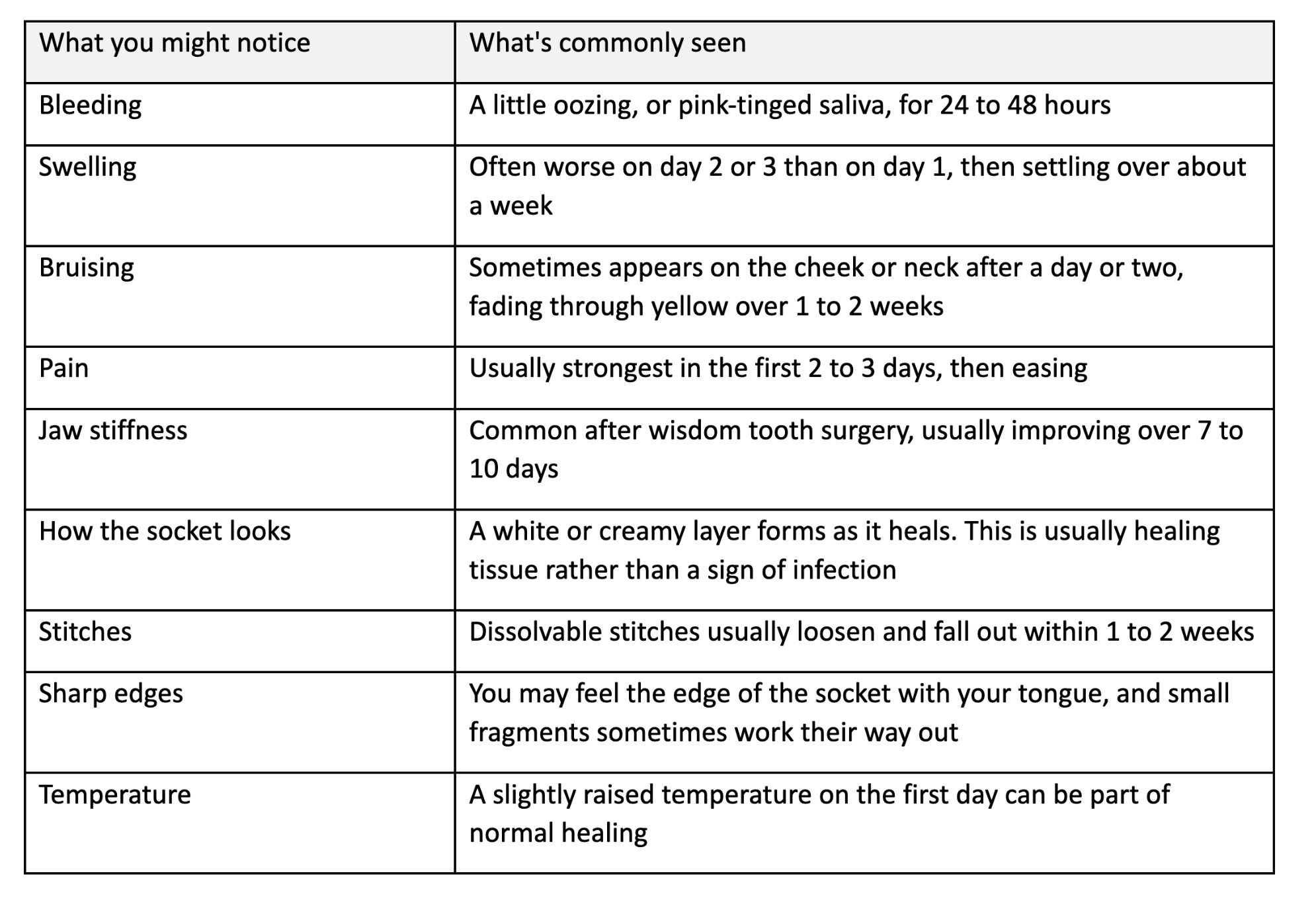
What's normal in the days afterwards
What matters most is the direction things are heading. For most people, things gradually get better after the first few days. If that isn't happening for you, please don't sit on it. Get in touch.
A special word about lower wisdom teeth
If you've had a lower wisdom tooth removed, recovery is often more noticeable than after a routine extraction. These teeth sit low in dense jawbone, close to the muscles you use to open your mouth. Taking them out often means lifting the gum and removing a little bone, so the area simply has more to recover from.
So please don't be alarmed if you notice:
More swelling. It usually builds over the first 2 to 3 days and can take 7 to 10 days to settle fully.
A stiff jaw. Gentle, regular opening and closing usually helps once the first day has passed.
Discomfort that travels to your ear, throat or the side of your face. This is common, but do tell us if it's severe or getting worse.
Bruising on the cheek or neck, especially in older patients.
A higher chance of dry socket than after other extractions.
Soft food, regular painkillers, rest and salt water rinses matter even more after wisdom tooth surgery. I'd suggest planning a few quieter days, and taking time off work if your job is physical. Before the operation, we discuss your individual risks with you as part of the consent process. These include altered sensation in the lip, chin or tongue, which is usually temporary but can rarely be permanent. If any numbness is still there the day after surgery, please contact NDU Clinic.
Looking after the socket from day two
From the next day, the focus shifts from protecting the clot to keeping things clean.
Warm salt water rinses. Stir half a teaspoon of salt into a glass of warm water. Swish gently, then let it fall out of your mouth rather than spitting hard. Do this after meals and before bed for about a week. It sounds simple, but in one small trial warm salt water was as effective as a chlorhexidine mouthwash at preventing dry socket after wisdom tooth surgery.²
Keep brushing. Clean your other teeth as usual and brush gently near the socket. A clean mouth supports healing.
Eat soft, nourishing food. Warm (not hot) soup, eggs, yoghurt, pasta and mashed vegetables are all good choices. Chew on the other side, and give crunchy, seedy or very spicy food a miss for a few days.
Drink plenty of water. Staying hydrated helps you feel better and supports healing.
Stay off cigarettes and vapes for as long as you can. At least 48 to 72 hours, and ideally until the socket has closed. Smoking is a well-recognised risk factor for dry socket.
Ease back into exercise. Light activity is usually fine after a couple of days, unless you've been advised otherwise. Save heavy workouts until the swelling has settled.
If the bleeding starts again, try not to panic. Sit upright, fold a clean damp gauze or cloth, and bite firmly on it for 30 minutes. A damp tea bag can also help. Tea contains tannins, and small clinical trials have found that gauze soaked in tea extract helps extraction sockets stop bleeding sooner.³ ⁴
Managing pain
For many extractions, over-the-counter painkillers are all that's needed. Paracetamol, ibuprofen, or the two together are common choices, taken as directed on the packet unless your surgeon, doctor or pharmacist advises otherwise. A tip I often share: take your first dose before the local anaesthetic wears off, so you stay ahead of the discomfort.
Ibuprofen isn't suitable for everyone. That includes some people with asthma, stomach ulcers or kidney problems, anyone who is pregnant, and people taking blood thinners. If you're not sure, your pharmacist is a great person to ask. It's best to avoid aspirin as a painkiller after an extraction, as it can increase bleeding. But please don't stop a prescribed blood thinner, including aspirin taken for your heart, unless your doctor or surgeon has told you to.
Always follow any specific advice you've been given, and never take more than the maximum dose on the label.
When to contact NDU Clinic
Please call us on +44 20 7935 5281 if your recovery stops following the usual pattern. You're never bothering us. Many of these problems can be managed effectively, and it's always better to be seen early. If something worries you, even if it isn't on this list, get in touch.
Bleeding that won't stop after two rounds of 30 minutes of firm pressure.
Pain that's getting worse rather than better after day 3, or that painkillers no longer control.
Swelling that keeps increasing after day 3, or comes back once it has settled.
Signs of infection, such as a fever, feeling generally unwell, pus, or a bad taste or smell that won't go away.
Numbness that lingers. Let us know if your lip, chin or tongue is still numb the day after surgery.
Air or fluid passing into your nose after an upper tooth has been removed. Try not to blow your nose, and contact us promptly.
A stiff jaw that's getting worse rather than gradually easing.
A word about dry socket
Dry socket happens when the blood clot is lost or breaks down too early. It typically starts 2 to 4 days after the extraction. Patients often describe a deep, throbbing ache that spreads towards the ear, usually with an unpleasant taste, and the socket may look empty. It's more common after lower wisdom teeth and in smokers. In one systematic review, about 13% of smokers developed dry socket, compared with about 4% of non-smokers.¹
Hormones can play a part too. The combined contraceptive pill roughly doubles the risk: in two meta-analyses, women taking it had close to twice the rate of dry socket of women who were not.⁵ ⁶ Hormone replacement therapy (HRT) also contains oestrogen, but it has barely been studied in relation to dry socket, so its effect isn't known. If you take the pill or HRT, please don't stop it without medical advice, but do let your surgeon know before your extraction.
Dry socket isn't usually caused by infection, and antibiotics aren't normally needed. A medicated dressing placed in the socket can ease the pain, so please call us rather than putting up with it.
Get urgent help straight away
Call 999 or go to A&E if you have:
difficulty breathing or swallowing
swelling spreading quickly to your eye, neck or under your tongue
heavy bleeding that pressure won't control
If the clinic is closed and it isn't an emergency, call NHS 111 for advice.
How healing progresses
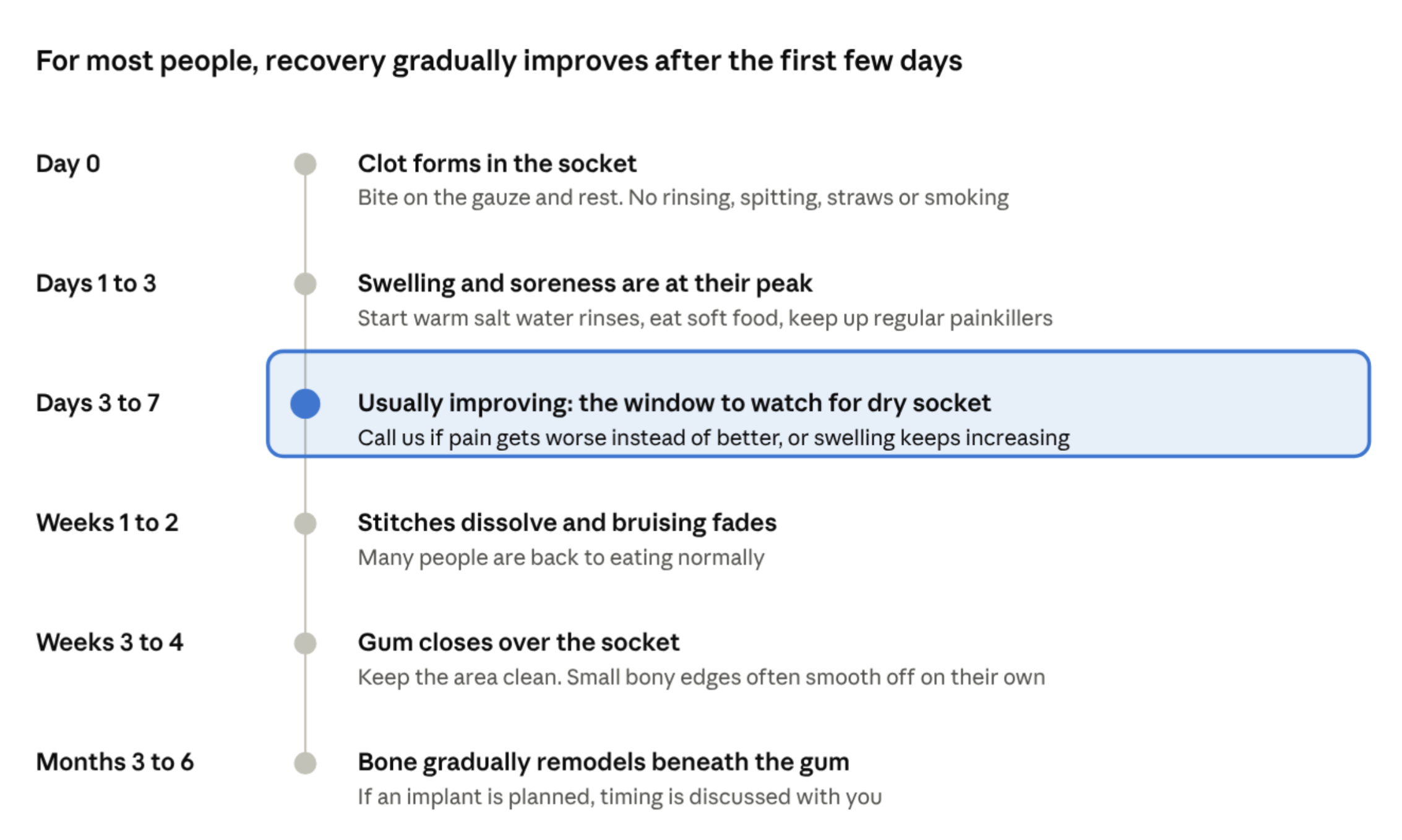
healing timeline · day 0 to month 6
How healing progresses
Everyone heals at their own pace, and surgical extractions such as wisdom teeth can take a little longer. In general, discomfort and swelling tend to peak around days 2 to 3 and then gradually improve.
The bottom line
A little discomfort, swelling and oozing are a normal part of healing. Look after the clot on day one, keep the area clean from day two, and give yourself time. Most people find things gradually improve after the first few days. If yours don't, or you're worried at any point, please contact NDU Clinic. We'd much rather hear from you.
Dr Arash Zaker Shahrak is a GDC-registered Specialist in Oral Surgery (GDC No. 78796). This article provides general information only. It is not a substitute for a consultation or for the individual instructions you receive after your procedure, which take priority. Recovery varies between individuals and procedures, and this article does not describe every possible complication. In an emergency, call 999 or go to A&E. If you have any concerns after your procedure, contact NDU Clinic on +44 20 7935 5281 or visit nduclinic.com.
References
Kuśnierek W, Brzezińska K, Nijakowski K, Surdacka A. Smoking as a risk factor for dry socket: a systematic review. Dentistry Journal. 2022;10(7):121. doi:10.3390/dj10070121
Osunde OD, Anyanechi CE, Bassey GO. Prevention of alveolar osteitis after third molar surgery: comparative study of the effect of warm saline and chlorhexidine mouth rinses. Nigerian Journal of Clinical Practice. 2017;20(4):470–473. doi:10.4103/1119-3077.180064
Soltani R, Haghighat A, Fanaei M, Asghari G. Evaluation of the effect of green tea extract on the prevention of gingival bleeding after posterior mandibular teeth extraction: a randomized controlled trial. Evidence-Based Complementary and Alternative Medicine. 2014;2014:857651. doi:10.1155/2014/857651
Hamid MMM, Al-Amer SS, Alahmari JD, et al. Clinical effectiveness of green tea extracts as a local haemostatic agent following mandibular molar extraction. Journal of the College of Physicians and Surgeons Pakistan. 2024;34(11):1281–1286. doi:10.29271/jcpsp.2024.11.1281
Xu J-L, Sun L, Liu C, et al. Effect of oral contraceptive use on the incidence of dry socket in females following impacted mandibular third molar extraction: a meta-analysis. International Journal of Oral and Maxillofacial Surgery. 2015;44(9):1160–1165. doi:10.1016/j.ijom.2015.05.017
Bienek DR, Filliben JJ. Risk assessment and sensitivity meta-analysis of alveolar osteitis occurrence in oral contraceptive users. Journal of the American Dental Association. 2016;147(6):394–404. doi:10.1016/j.adaj.2016.01.011